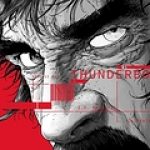
Shit, I never talked about Strikeforce Morituri, did I?
Okay, so this is set in the future, aliens have arrived in the solar system and they’re hostile, but rather than invade Earth they sit with some of their fleet in close orbit and the bulk of it out behind the Moon and Mars, and they’re content to raid the planet for resources, technology, people and stuff. Human technology isn’t up to stopping them, and influenced by old comics they develop the Morituri Process, which only works on a small percentage of people, but it grants them superpowers. the snag is it kills you within a year of your powers manifesting. The Morituri team are the best and last line of defense for humanity, but they can’t be everywhere, and they’re too valuable to risk on just any mission, which is often highly frustrating for the members.
While the story is setup as an SF actioner, and there’s a decent amount of SF and action, under original writer Peter Gillis it’s very much a meditation on power, mortality and war as a concept. The Morituri team are often highly frustrated by the orders they’re given, they see their time on earth ticking away. The people who are in charge work hard to insulate themselves from emotional connections with the team because they know they’re going to die. Ove the course of the first 24 issues something like fifteen members of the team are introduced and die, generally shortly after someone starts to gain focus they’re about to go out in a tragic and or heroic way. but Gillis’ writing is skilled enough that he draws you in effectively pretty much every time even as you know he’s only focusing on a character so you like them more when they die.
It’s also very interesting how the aliens, The Horde are portrayed. They’re scavengers who stole spacecraft from a peaceful race who visited their homeworld (and were subsequently slaughtered), like the origin of the Mirror Universe in Enterprise. They don’t really have a culture beyond taking and fighting, they’re adorned with the ephemera of the people they steal from – most notably from humans they’re often festooned in badges and pins which clues you in that a lot of their other stuff is probably stolen as well. The comic is explicitly set in a world where Marvel comics exist and were an influence on developing the Morituri Process, but there are fun little easter eggs like various cosmic weapons from DC and Marvel (and Cap’s shield!) showing up in The Horde’s loot.
After Gillis and Anderson departed the book, James Hudnall took over as writer with a few artists before they settled on Mark Bagley for the last 6 issues. The comic shifts massively in focus and tone, with a mysterious alien wiping out The Horde before vanishing, and the story moving to a conspiracy plot about the rulers of the world using the process to make a team of super-powered assassins who are tasked with killing the surviving Morituri team members, anyone still involved with the process and a selection of political leaders and businessmen. It’s a clear critique of the military-industrial complex and very James Hudnall. Hudnall and Bagley also did a five-issue sequel called Electric Undertow which was published under the Epic imprint and is a follow up to a few leftover plots from the conspiracy side of things as well as bringing the mysterious aliens back, and works well enough as a coda to the main book.
If I have a complaint about the comic story-wise it’s that it doesn’t do enough with the war and the implications of the horrors therein. Early on we learn that the Horde are taking slaves, and often chucking them out the airlock so they’ll visibly burn up as they fall back to Earth as a demoralising tactic. Or in one of the first stories they’ve beheaded some of their captives and wired their heads into mechs they deploy against the Morituri team, so when they engage in close combat they’re confronted with a person begging them to kill them. That macabre side of the story fades away pretty fast and I was enjoying it as part of the motivations for the team to fight as hard and passionately as they do.
Art-wise, it’s most good to great. Brent Anderson’s the highlight for sure, his work isn’t up to the standard of his work on God Loves, Man Kills but it’s close. Incredibly expressive faces, great line usage, it reminded me of Neal Adams and Alan Davis at points. There are a couple of fill-ins on his run by Whilce Portacio in some of his earliest penciling credits, who presumably got the nod through Scott Williams, who inked all of Anderson’s issues. I’m a bit of a Portacio apologist, I like a lot of his stylistic choices even as he’s not the best storyteller, and it’s in that zone where he hasn’t got his style down and he’s not strong enough in other areas to compensate. Not the worst art the book will see, but not the best. Speaking of the worst art, it’s absolutely Huw Thomas and John Calimee, who do four of Hudnall’s eleven issues on the book, including some of the pivotal moments that see the Horde destroyed and really aren’t up to the task with low-detail, turgid art. Bagley’s not my favourite artist but he’s at least competent in his worst moments. I’ll call out Electric Undertow as a highlight of Bagley’s art for the book, I suspect he had extra time to work on it, and the colours evoke a watercolour look that Marvel used a few times on Epic comics and some Bookshelf format one-shots.
So yeah, the Gillis/Anderson run is fantastic and well worth checking out. Hudnall and Bagley is good but not as good and your tolerance for Hudnall’s pet bugaboos might detract.
4 users thanked author for this post.